Wednesday, July 16, 2014

The 2014 State of the Microcredit Summit Campaign Report Emphasises Resilience

photo by BRAC

by Mark Rice, RESULTS Australia's Global Health Campaigns Manager

Microfinance (the provision of credit and financial services to the poorest people) has been one of RESULTS Australia’s advocacy priorities for many years.  The lack of access to financial services adds to the vulnerability of poor people, as they are unable to obtain credit on reasonable terms to start or grow small enterprises, obtain insurance to protect against unexpected costs or loss of income or have a safe place for savings.  Therefore, increasing access to financial services is an important strategy in poverty reduction.

RESULTS Australia has been a strong supporter of the Microcredit Summit Campaign  since its launch in 1997.  The original goal of the Campaign was to reach 100 million of the world’s poorest families – those living on less than $US 1.25 per person per day - with credit and other financial services by 2005.  In 2006, the Campaign took on two new goals for 2015:
  •  Reaching 175 million poorest families with microfinance. 
  • Helping 100 million families lift themselves out of extreme poverty.

From 1997 to 2010, the Microcredit Summit Campaign had been able to report phenomenal growth in the number of the poorest people accessing credit and financial services, with the numbers increasing from 8 million people in 1997 to 138 million in 2010.

Resilience: The State of the Microcredit Summit Campaign Report 2014   was launched last month and provides an update on what is happening in client numbers, and also on innovations in microfinance that are better meeting the needs of people who are living in extreme poverty and building the resilience of clients. 

In 2010, the strong growth of microfinance came to an abrupt halt, as the State of Andhra Pradesh in India, which had been a hotspot for growth in microfinance, introduced restrictive new regulations on microfinance operations, designed to address the massive over-indebtedness and aggressive collection practices by some institutions caught up in a fever of sustained double-digit growth in client numbers.

In 2011, the Microcredit Summit Campaign reported that, for the first time since 1997, the total number of borrowers, and the number of very poor borrowers, both declined. The latest State of the Campaign Report shows that in 2012 (the latest available information) the total number of clients rebounded to 204 million, while the number of poorest clients continued to fall, from 124 million to 116 million.

The chart below shows the long-term growth and recent interruption of growth in the number of very poor borrowers.


This result seems like bad news, suggesting that microfinance institutions are becoming less focussed on serving the poorest people.  However, Microcredit Summit Campaign Director Larry Reed explains that these results are more encouraging than they seem;
  “We found that most of the decline can be explained by MFIs making increased use in recent years of poverty measurement tools like the Progress out of Poverty Index (PPI) or the Poverty Assessment Tool (PAT) in which they often found that they were overestimating their poverty outreach. In the long run, we believe that increased use of these tools will lead to more people in extreme poverty being reached with products and services that better meet their needs. We’ve already seen this start to happen in the Philippines, where 10 of the largest MFIs began using the PPI at the same time. This led these MFIs to begin looking at what prevented people living in extreme poverty from becoming clients and to developing policies, systems, and services that could include the poorest. As a result, the numbers of poorest clients started going up again in 2012.”

The 2014 State of the Campaign Report highlights some strategies that microfinance institutions and governments can adopt to assist the poorest people move out of poverty:
  • Providing health education, financing, and products through the existing channels for delivering microfinance.
  • Building agricultural value chains that reach small scale producers in rural areas.
  • Using digital cash and banking agents to deliver financial services at much lower costs.
  • Combining conditional cash transfers with ultra-poor graduation programs to provide pathways out of poverty for massive numbers of people.

 At around the same time as the release of the 2014 State of the Campaign Report, the Australian Government released its aid policy statement, Australian Aid: promoting prosperity, increasing stability, reducing poverty.   Three of the priorities the Government has set for the aid program are:
  • Promoting private sector development.
  • Building resilience (including disaster risk reduction and social protection).
  • Gender equality and empowering women and girls.

Effective microfinance programs are relevant to all of these objectives.  For example, microfinance institutions can offer insurance and loans to rebuild businesses after a natural disaster (adding to resilience) and the majority of clients of microfinance institutions are women (as they have most difficulty in accessing mainstream financial services and are most likely to use additional income to benefit their families).

Therefore, it is essential for us to continue to call on the Australian Government to incorporate microfinance in its aid to countries in the Asia-pacific region.  

Wednesday, July 9, 2014

Every child's right to a quality education - making it a reality


by Camilla Ryberg, RESULTS Australia's Online Communications and Education Manager

It sounds obvious and we’ve heard it many times before. Every child has the right to a quality education.

So how is it that a few weeks ago we were told that there were 57 million primary school-aged children not in school and today there are 58 million according to newly released data from UNESCO Institute for Statistics?

We are clearly not doing enough to make the right of every child to an education a reality. Indeed, world-renowned economist Jeffrey Sachs recently called universal basic education the “millennium goal everyone forgot”.

On 26 June, leaders from around the world came together at the Global Partnership for Education’s (GPE) second replenishment conference in Brussels to address this discrepancy.

Hosted by the European Commission, the conference brought together 800 delegates including more than 40 ministers, education experts, and representatives from multilateral organisations, civil society, business and youth leaders from 91 countries.

Pledges of more than US$28.5 billion in additional funding for education for millions of children in more than 60 developing countries were made. This is a significant step in the direction towards making education for all a reality.

The outcome was driven by commitments by 27 developing country partners to increase their own education budgets by US$26 billion, or 25 percent, between 2015 and 2018.

Pledges were also made by many civil society organisations (including RESULTS), multilaterals, private philanthropic foundations and the first pledge of an innovating financing resource – loan buy-down arrangements from the Islamic Development Bank valued at more than US$400 million.

There were a few generous pledges from the United Kingdom, the European Commission and some Scandinavian countries, but most donors seemed not quite as willing as their developing country partners to make the right to education a reality.

Of the US$3.5 billion target, only US$2.1 billion was raised at the replenishment conference.

The US will contribute US$50 million in 2015 to the GPE fund – the equivalent of one hour of Pentagon spending.

Australia halved its contribution, announcing an AU$140 million four-year commitment (or less than US$33 million per year). Is this consistent with Minister for Foreign Affairs Julie Bishop’s assurance that education is a ‘central pillar’ of the Australian aid program?

Surely Australia can do better.

Overall, pledges by donors to the GPE Fund did increase more than US$600 million, or 40 percent, compared to the last replenishment pledging conference in Copenhagen in 2011.

GPE’s CEO Alice Albright said it is “a powerful start to achieving the goal we set of US$3.5 billion in donor commitments for the Partnership's four-year replenishment period. We’re looking forward to further commitments in the coming months”.

With aid to education falling by 10% in the last four years, and the target for the GPE fund not yet reached, donor country governments, including Australia, should meet the level of ambition set by developing country partners and those donors who have made significant contributions.

The Global Partnership for Education is the only multilateral partnership devoted to getting all children into school for a quality education in the world's poorest countries.

A child’s right to a quality education. It’s hard to imagine a better investment than making it reality.


Read our media release on the Australian pledge

Friday, June 27, 2014

The power of being non-partisan

 Jim Grant, former Executive Director of UNICEF, visits a classroom in Bangladesh. photo: UNICEF

by Gina Olivieri, RESULTS Australia's Grassroots Engagement Manager

"Why do you provide condoms to sex workers? Why do you provide lube to men who have sex with men? Why do you exchange needles for drug users?”

These are questions often posed to our advocate friends in Kenya who are working to eliminate HIV in their communities.

The underlying assumption of questions like this, particularly in conservative settings, seems to be ‘these people are dirty, they are not worthy of your help.’

The answer given by the Kenyan advocate, incidentally, was love. They show love to all people who need their help to protect themselves and the community from a killer virus; by simply helping them without judgment.

This comment and others throughout the day got me thinking of another story. They got me thinking of the late Jim Grant, hugely influential former Executive Director of UNICEF who led the ‘child survival revolution’ throughout the 80s and 90s. Grant was often criticised for being photographed shaking hands with dictators; before or after having just met with them to discuss some sort of child survival intervention such as vaccination or oral rehydration salts.

He ‘shook hands that were stained with blood, hands that had turned the keys on political prisoners, hands that had signed away human rights, hands that were deep in the country’s till.’
This was not taken well, as many thought he shouldn’t be tainting UNICEF’s name by associating with such corrupt and even evil regimes.

Grant’s answer was as pragmatic as you would expect – “We don’t like the President so the kids don’t get immunized? You want to wait to launch the campaign until all governments are respectable?”
Grant recognised that as advocates, we don’t always get to choose who has the key to unlock interventions that can save lives. We could probably individually find a reason to avoid engaging with every single political leader or person of influence; for reasons trivially annoying to morally reprehensible.

But if we avoid engaging with them, what do we gain? And more importantly, what do we lose?
We lose the opportunity to influence somebody to be a champion for child health. Despite their evil reputations and deeds, Jim Grant was able to convince some notorious dictators that child health was important and deserving of resources. Had he not done that, those children would have been in exactly the same state as before – dying of preventable diseases or dehydration for a lack of simple, inexpensive interventions.

Our power is in our non-partisan stance. If we eliminate individuals, or even whole sides of politics from the dialogue, we miss the opportunity to build champions, who we have seen from experience, can come from surprising places. They may not be the ones we would have chosen, but they are in a place of influence. It’s our job to ensure that influence is used well.

Reference: http://www.unicef.org/about/history/files/Jim_Grant_unicef_visionary.pdf

Thursday, June 12, 2014

Greater Impact through Partnership: 8 reasons to invest in the Global Partnership for Education

On June 26, 2014, leaders from around the world will convene at the Global Partnership for Education Pledging Conference to decide the future of education for children in the most poverty-stricken and conflict-affected countries on the planet. This brief explores 8 critical reasons why now, more than ever, donors and development actors must ambitiously support GPE’s work over the 2015-2018 period. Written with RESULTS Education for All campaign affiliates in Australia, Canada, the UK, and the US, "Greater Impact Through Partnership: 8 reasons to invest in the Global Partnership for Education now more than ever" provides the critical information and data we need to move the Australian government to pledge AU$500 million over four years to the Global Partnership for Education.

Over the 8 weeks following the release of the brief, RESULTS and its affiliates developed an 8-part blog series covering each of the 8 reasons. Click on the image to read the relevant blog post.

http://resultsinternationalaustralia.blogspot.com.au/2014/03/reason-1-to-invest-in-gpe-we-cannot-end.html

http://resultsinternationalaustralia.blogspot.com.au/2014/04/reason-2-to-invest-in-global.html 

http://resultsinternationalaustralia.blogspot.com.au/2014/04/reason-3-global-partnership-for.html

http://resultsinternationalaustralia.blogspot.com.au/2014/04/over-eight-weeks-results-affiliates-in-u.html

http://resultsinternationalaustralia.blogspot.com.au/2014/05/reason-5-global-partnership-for.html


http://resultsinternationalaustralia.blogspot.com.au/2014/05/reason-6-global-partnership-is-taking.html


http://resultsinternationalaustralia.blogspot.com.au/2014/05/reason-7-global-support-to-basic.html 

http://resultsinternationalaustralia.blogspot.com.au/2014/05/reason-8-demand-for-global-partnership.html

Joining us in our campaign are world leaders and 98 Civil Society Organisations from around the world calling for generous support to the Global Partnership for Educatio.

And have you told the world what you have achieved #BecauseOfSchool?

Friday, June 6, 2014

Undernutrition is a smart development investment: Why delay?


By Tiruni Yasaratne, Global Health  Researcher Volunteer

In 2013, the Lancet published an ‘eyebrow raising’ statistic: undernutrition contributes to 45% of all child mortality worldwide. Of the seven million children around the world who die before their fifth birthday, nearly half of these die from undernutrition. Undernutrition, is in fact, a major global public health problem, with almost one in four children under-five stunted and 52 million children wasted.

The World Bank “At a glance” nutrition series shows that the economic costs of undernutrition include direct costs such as increased burden on health care systems, and indirect costs of lost productivity. Childhood anemia alone is associated with 5% drop in future adult wages!

Donor nations, countries and agencies came together in June 2013 at the Nutrition for Growth Summit in London, and made pledges for increased spending on nutrition interventions. Australia committed $40 million over four years for nutrition activities in the region.

A recent report, "Undernutrition in the Land of Rice", by RESULTS UK and RESULTS Australia on undernutrition in Cambodia reveals some distressing facts:
  • On average undernourished children enroll in school later and complete fewer years of school
  • Only a third of undernourished children go on to secondary school with completion rates very low 
  • Undernourished children have weakened immune systems and are more likely to contract communicable diseases (TB for example)  – Studies in India show that a patient who is diagnosed with TB and also undernourished is two times more likely to die than a non-malnourished TB patient!
  • Maternal undernutrition is high – Anaemia caused by low consumption of iron rich foods is very high in women of reproductive age and is a leading cause of maternal deaths and linked to adverse birth outcomes such as low weight babies. It also leads to reduced ability to concentrate, and ability to do manual labour.
Cambodia has an average economic growth rate of 7% per annum; yet 40% of its children under five are too short for their age. Where did Cambodia go wrong in relation to nutrition related investment?

A common understanding in the development community is that economic growth will improve nutrition. The Cambodian case proves otherwise.  Sadly, Cambodia is far from unique in struggling with this issue –14 countries have a child stunting rate of over 30% in the Asia Pacific region. 

Economic growth needs to be funneled in a targeted way to have an improvement on nutrition. Too often nutrition has been neglected, as there’s no easy single solution to implement. Our Cambodian report advocates for a stand alone indicator on nutrition and food security to be incorporated into the post-2015 development goals, to ensure nutrition is prioritised.

In a nutshell, Cambodia needs to invest more in nutrition interventions. But in a country with already competing development priorities, is it a cost effective option?

In 2013, the Lancet brought together the worlds nutrition experts, who found that a combination of ten interventions can make significant improvements in nutritional status at a relatively low cost.

Areas worthy of scale up include:
  • Infant feeding practices - Support early start of breastfeeding (within the hour), continued exclusive breastfeeding until age six months, and timely introduction of complementary foods;
  • Access to a diverse range of food through crop diversification;
  • Nutrition education, in schools and primary health care centres, and by community health workers;
  • Micronutrient fortification - According to the Micronutrient Initiative, “specifically providing vitamin A and zinc, provides the most beneficial return on investment of any development intervention”. Fortification is also most successful when it is mandated by law. 
  • Conditional Cash Transfers- These provide a small income to families, with a conditional element that encourages them to engage with social programmes, including health and primary education. Evidence from major programmes (e.g. in Mexico and Brazil) shows that the interventions are most effective when they reach children during their first two years of life.
  • Access to water and sanitation to combat disease - WHO estimates that 50% of undernutrition is associated with intestinal worm infections or repeated diarrhoeal episodes due to insufficient access to clean water and sanitation.
Overall, annually, Cambodia loses over US$134 million in GDP to vitamin and mineral deficiencies according to UNICEF and World Bank database sources. This holds back the country’s growth and ambition to reach upper middle income country status.

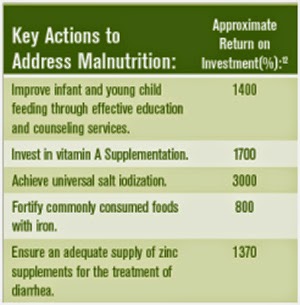
Amazingly, scaling up core micronutrient interventions would cost less than US$6 million per year. Addressing undernutrition is cost effective: Costs of core micronutrient interventions are as low as US$0.05–3.60 per person annually. Returns on investment areas high as 8–30 times the costs!

The World Bank states the returns on investment for addressing malnutrition include:

Source: The World Bank – Nutrition at a glance/Cambodia

Donor agencies, including Australia should publicise examples of their spending on nutrition interventions. Australia initiated the development of a holistic nutrition strategy soon after the London summit. However, due to changes in the aid programme in late 2013, there are no visible developments on it.

It is obvious that investing in nutrition programmes is tremendous value for money. With more bang for your buck, it is essentially an investment and not a cost. Keeping in line with new changes in Australian foreign aid whereby the Federal Government will soon introduce a performance evaluation system for foreign aid, with an emphasis on value for money, moving forward on the undernutrition strategy and developing comprehensive aid solutions to undernutrition is crucial for effective Australian aid.

Read the full report "Undernutrition in the Land of Rice"

Thursday, June 5, 2014

"Inspirational. Enriching. Regenerative." - Your experience at AIDS2014

Angie (far right) with RESULTS and ACTION friends at the AIDS march

AIDS2014 is the 20th International AIDS Conference and will be held in Melbourne from the 20th – 25th of July 2014. For the first time it will feature a dedicated hub for discussing the deadly duo of TB-HIV. Despite TB's status as the leading killer of people with HIV, responses to these two diseases are often disconnected, and collaboration on HIV and TB programs is weak in many places.
      
The TB/HIV Networking Zone at AIDS 2014 will provide a space for HIV and TB communities – researchers, affected communities, advocates, policy makers, donors, and more – to come together and chart a way forward for addressing these deadly diseases together.

We interviewed RESULTS Hobart Group Leader Angie about her experience at AIDS2012 and encourage all RESULTS advocates to consider joining in the activities at AIDS2014's Global Village following our National Conference.

1. What did you enjoy most about AIDS2012?
Being in Washington for AIDS2012 was an incredible experience. The Global Village was amazing and listening to such a variety of plenary speakers streamed live from the conference was a huge privilege. My favourite part was the AIDS march where thousands of people marched from the four corners of Washington to meet for a massive rally outside the White House! Incredible. And RESULTS marched with ACTION right up the front from our corner. Unbelievable!!

2. Describe your experience in 3 words.
Inspirational. Enriching. Regenerative.

3. Why do you think RESULTS advocates should join in with AIDS2014?
We need to learn from past mistakes with Malaria and TB that just because we 'cure' or 'eradicate' these diseases in our own country, it doesn't mean they are gone forever. We need to continue the fight for all three of these diseases, to get the best possible drugs and equipment to the wealthy and impoverished alike in all countries, and to eradicate AIDS, TB and Malaria across the world. WE ARE THAT GENERATION!! And if that fact ignites some passion in you to help fight this cause, AIDS2014 will inspire you beyond measure. Don't just think about it. DO IT!!!

4. What made your AIDS2012 experience unique? What did you get out of it that you couldn't get anywhere else?
I feel incredibly privileged that as a member of RESULTS working with the amazing advocates from ACTION, I was part of a movement that brought awareness to people from all over the world about TB and its relationship to HIV. There were so many people at the conference who wandered through the Global Village and almost fell over backwards when ACTION advocates would share this knowledge. The educative experience on a personal level was huge and bringing that awareness to others both in Washington and back home to Australia was life changing.

Don't forget to register for the RESULTS National Conference - and if you're keen to stay on and join in the activities at the TB-HIV Networking Zone at the AIDS2014 Global Village, please contact info@results.org.au

Wednesday, June 4, 2014

Australia recommits to eradicating ancient disease

Photo credit: GAVI Alliance

RESULTS Australia media release

RESULTS International (Australia) applauds the commitment re-iterated by the Australian government on Sunday to eradicate polio from the entire world. 

Australia will be investing $100 million into the campaign, with the aim of eradicating polio completely by 2018. This investment not only honours an aid commitment made by the previous Labor government, but also shows the Abbott government's dedication to eradicating the disease by extending and increasing our commitment.

This investment will be hosted by the Global Polio Eradication initiative (GPEI), which is the coordinating body for all international agencies working to eliminate and eradicate polio.

Polio is a viral disease that is transmitted through contaminated food and water, and multiplies in the intestine. It can affect the central nervous system, and causes paralysis in one in every 200 infections.
Since its establishment in 1988, GPEI has successfully reduced polio cases by more than 99%, from more than 300,000 per year to just 417 cases in 2013.

The announcement by the Foreign Minister came with the opening of Rotary's 105th International Convention on Sunday. Hosted in Sydney this week, Rotary's annual convention was opened Sunday by the NSW Premier Mike Baird and Prime Minister Tony Abbott and expects to see more than 18,000 international Rotarians. 

"Eradicating polio around the world has been an Australian project," said Samantha Chivers, Global Health Campaign Manager at RESULTS Australia. 

"It was a Queensland Rotarian, Sir Clem Renouf, who lived through the eradication of smallpox and had the vision that polio could be eradicated in the same way," Samantha continued. 

"Australian aid and community support has been vital in supporting GPEI and keeping the issue high on the agenda. Now we have to up the ante, as that last 1% will be the hardest."

India, a country of over one billion people, saw its last case of polio in 2010, and was certified polio-free by the World Health Organisation in March this year. India joins the Pacific, Southeast Asian, European and American regions in being completely polio free.

Polio now remains endemic in only three countries: Nigeria, Pakistan and Afghanistan. However, cases are beginning to re-emerge in countries including Ethiopia, Iraq, and Israel. War-torn Syria, whose health system has collapsed, was polio-free for 14 years, and was re-infected with the virus from Pakistan.

At the beginning of May, the World Health Organisation declared that the spread of polio is an international public health emergency.

Endemic polio is preventable by vaccination, with oral vaccination of three drops being the preferred method so far.

"The public health community has seen great success with the oral vaccine. However, in order to completely eradicate polio and not just prevent infection in an individual, an injectable vaccine is needed, and this complicates the logistics and increases the price substantially" Samantha said.

The GAVI Alliance is the leading partnership providing vaccines to the developing world at low prices. GAVI announced earlier this year that it will begin supporting injectable polio vaccine (IPV) to 73 of the poorest countries in the world by the end of the year.

"We are very encouraged by the commitment made yesterday," Samantha said, "Increasing vaccination is a very effective use of our aid money. Now we need to see more support made to GAVI as well, so we can completely destroy this ancient disease forever."