Showing posts with label global health. Show all posts

Friday, June 6, 2014

Undernutrition is a smart development investment: Why delay?


By Tiruni Yasaratne, Global Health  Researcher Volunteer

In 2013, the Lancet published an ‘eyebrow raising’ statistic: undernutrition contributes to 45% of all child mortality worldwide. Of the seven million children around the world who die before their fifth birthday, nearly half of these die from undernutrition. Undernutrition, is in fact, a major global public health problem, with almost one in four children under-five stunted and 52 million children wasted.

The World Bank “At a glance” nutrition series shows that the economic costs of undernutrition include direct costs such as increased burden on health care systems, and indirect costs of lost productivity. Childhood anemia alone is associated with 5% drop in future adult wages!

Donor nations, countries and agencies came together in June 2013 at the Nutrition for Growth Summit in London, and made pledges for increased spending on nutrition interventions. Australia committed $40 million over four years for nutrition activities in the region.

A recent report, "Undernutrition in the Land of Rice", by RESULTS UK and RESULTS Australia on undernutrition in Cambodia reveals some distressing facts:
  • On average undernourished children enroll in school later and complete fewer years of school
  • Only a third of undernourished children go on to secondary school with completion rates very low 
  • Undernourished children have weakened immune systems and are more likely to contract communicable diseases (TB for example)  – Studies in India show that a patient who is diagnosed with TB and also undernourished is two times more likely to die than a non-malnourished TB patient!
  • Maternal undernutrition is high – Anaemia caused by low consumption of iron rich foods is very high in women of reproductive age and is a leading cause of maternal deaths and linked to adverse birth outcomes such as low weight babies. It also leads to reduced ability to concentrate, and ability to do manual labour.
Cambodia has an average economic growth rate of 7% per annum; yet 40% of its children under five are too short for their age. Where did Cambodia go wrong in relation to nutrition related investment?

A common understanding in the development community is that economic growth will improve nutrition. The Cambodian case proves otherwise.  Sadly, Cambodia is far from unique in struggling with this issue –14 countries have a child stunting rate of over 30% in the Asia Pacific region. 

Economic growth needs to be funneled in a targeted way to have an improvement on nutrition. Too often nutrition has been neglected, as there’s no easy single solution to implement. Our Cambodian report advocates for a stand alone indicator on nutrition and food security to be incorporated into the post-2015 development goals, to ensure nutrition is prioritised.

In a nutshell, Cambodia needs to invest more in nutrition interventions. But in a country with already competing development priorities, is it a cost effective option?

In 2013, the Lancet brought together the worlds nutrition experts, who found that a combination of ten interventions can make significant improvements in nutritional status at a relatively low cost.

Areas worthy of scale up include:
  • Infant feeding practices - Support early start of breastfeeding (within the hour), continued exclusive breastfeeding until age six months, and timely introduction of complementary foods;
  • Access to a diverse range of food through crop diversification;
  • Nutrition education, in schools and primary health care centres, and by community health workers;
  • Micronutrient fortification - According to the Micronutrient Initiative, “specifically providing vitamin A and zinc, provides the most beneficial return on investment of any development intervention”. Fortification is also most successful when it is mandated by law. 
  • Conditional Cash Transfers- These provide a small income to families, with a conditional element that encourages them to engage with social programmes, including health and primary education. Evidence from major programmes (e.g. in Mexico and Brazil) shows that the interventions are most effective when they reach children during their first two years of life.
  • Access to water and sanitation to combat disease - WHO estimates that 50% of undernutrition is associated with intestinal worm infections or repeated diarrhoeal episodes due to insufficient access to clean water and sanitation.
Overall, annually, Cambodia loses over US$134 million in GDP to vitamin and mineral deficiencies according to UNICEF and World Bank database sources. This holds back the country’s growth and ambition to reach upper middle income country status.

Amazingly, scaling up core micronutrient interventions would cost less than US$6 million per year. Addressing undernutrition is cost effective: Costs of core micronutrient interventions are as low as US$0.05–3.60 per person annually. Returns on investment areas high as 8–30 times the costs!

The World Bank states the returns on investment for addressing malnutrition include:
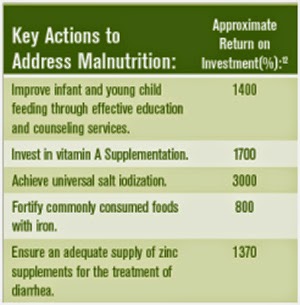
Source: The World Bank – Nutrition at a glance/Cambodia

Donor agencies, including Australia should publicise examples of their spending on nutrition interventions. Australia initiated the development of a holistic nutrition strategy soon after the London summit. However, due to changes in the aid programme in late 2013, there are no visible developments on it.

It is obvious that investing in nutrition programmes is tremendous value for money. With more bang for your buck, it is essentially an investment and not a cost. Keeping in line with new changes in Australian foreign aid whereby the Federal Government will soon introduce a performance evaluation system for foreign aid, with an emphasis on value for money, moving forward on the undernutrition strategy and developing comprehensive aid solutions to undernutrition is crucial for effective Australian aid.

Read the full report "Undernutrition in the Land of Rice"

Thursday, May 1, 2014

Immunisation in the Indo-Pacific: Is Australia up to date?


by Samantha Chivers, Global Health Campaign Manager (Maternal, Child and Neonatal Health) with RESULTS Australia

On World Immunisation Week this year, RESULTS Australia is celebrating the work of the GAVI Alliance, a public-private partnership that has had phenomenal success in getting underused vaccines to children in the poorest countries in the world.

It is clear GAVI is a worthwhile investment for Australia, as it aligns very strongly with Australian foreign policy priorities in several ways.

Here are five reasons why:

1.
GAVI was rated extremely highly in a 2012 Australian Government evaluation, as it “[saves] lives through cost-effective and evidence-based interventions”. Australia’s Foreign Minister Julie Bishop has recently publicly praised GAVI, calling it “the kind of thinking we need”.  GAVI also strongly emphasises results-based financing, which aligns with Australia’s interest in linking aid spending to performance benchmarks.

2.
In 2011, Australia pledged $200 million to the GAVI Alliance. This funding alone vaccinated an estimated 37 million children against a range of childhood diseases, including 3.3 million children vaccinated against pneumococcal pneumonia. These vaccinations will avert over half a million future deaths.

Our investment has also supported the development of stronger health systems in over 50 countries, including Indonesia, Myanmar, Vietnam and the Solomon Islands. This will not only provide the foundation for successful immunisation programs, but also prioritise strong and sustainable health system financing within recipient governments.

3.
Australian partnership and leadership in the Indo-Pacific region is vital. GAVI has a large influence in the Asia-Pacific region: seventeen of the countries that have received GAVI support are also Australian aid priority countries.

It also shows the strength of Australian research: GAVI focuses on rolling out new and underused vaccines, and this has most recently included human papillomavirus (HPV) vaccine to protect girls and women against cervical cancer, an Australian-developed vaccine. In two years, 21 of the poorest countries in the world have been approved to introduce HPV vaccine with GAVI support, including Laos and the Solomon Islands. Through negotiating a new record low price of $4.50 per dose of HPV vaccine, GAVI hopes to reach more than 30 million girls in more than 40 countries by 2020.

4.
The GAVI Alliance works to improve global vaccine markets to ensure adequate supply of appropriate, quality vaccines at low and sustainable prices. This involves working with private pharmaceutical companies in countries such as Indonesia, to support their access to global vaccine markets, so they can make new and underused vaccines for their own regions. GAVI has had great success in creating jobs in vaccine production. In 2001, there were 5 vaccine suppliers to GAVI, 1 based in an emerging market. By mid-2013, there were 12 vaccine suppliers to GAVI, with over half now based in Africa, Asia and Latin America. One outstanding example is the rollout in late 2013 of the locally produced pentavalent vaccine in Indonesia: protecting children against five diseases in one shot, this will now be produced by the Indonesian pharmaceutical industry.

GAVI is also very conscious to introduce regional-specific vaccines. Japanese encephalitis (JE), for example, is a serious mosquito-borne viral disease that kills over 15,000 people per year. Late last year, Chinese manufacturers obtained qualifications from the World Health Organisation to begin producing JE vaccines. This vaccine will be going to eight countries in Asia at risk of JE transmission.

5.
Consistent with recent trends in Australian aid, GAVI will be investing more time and resources in strengthening health systems, especially in fragile and conflict-affected states. Considering the intense focus of the Australian military and the foreign policy department on building the governance and resilience of countries like Myanmar and Afghanistan, developing strong policies to ensure equitable access to immunisations will assist in building strong health systems.

The countries that make up the Indo-Pacific are diverse and complex, and so are their needs. Extreme poverty co-exists on the same streets as comfortable families and the megarich, more so than anywhere else on earth. RESULTS Australia works to ensure the poorest countries in the world benefit from evidence based health policy.

Vaccines decrease poverty. There it is. GAVI works with the poorest countries to get new and underused vaccines on the ground to the families that need them. GAVI is on track to immunise half a billion children by 2015, and save more than nine million lives by the end of the decade. Although Australia works with a smaller aid budget than in previous years, GAVI is an excellent investment for Australia, and for the world.

This post was originally published on the ACTION Global Health Advocacy Partnership blog

Monday, February 24, 2014

TB/HIV Advocate Carol Nawina Nyirenda Honored By Dalai Lama


This weekend, ACTION partner and RESULTS' friend Carol Nawina Nyrienda was honored by His Holiness the Dalai Lama as an "Unsung Hero of Compassion" - an award recognizing leaders around the globe who work to alleviate the suffering of others without expectation of reward.

Carol spoke at AIDS 2012 and will return to AIDS 2014 in Melbourne. Many of RESULTS Australia's advocates will recognise her from her attendance at our National Conference 2010.

Carol is the Executive Director of CITAM+ in Zambia, a  patient-led organization providing Zambians with life-saving information and care. The profile below is reposted from Unsung Heroes of Compassion.

Carol Nawina Nyirenda is tireless—one day advocating at the World Health Organization, another speaking at an international AIDS conference, yet another building a rural health clinic in her native Zambia. What gives this passionate, articulate activist her energy is that, unlike many of her friends and family, she has survived HIV.

“There must be a reason why I’m still alive,” she says. “I went to rock bottom, but I survived. I want to inspire people by showing them that you can be HIV-positive and still lead a normal, productive life.”

Born in rural Zambia in 1963, Carol was leading a middle-class life with her husband and two children when people around her began dying of a disease not seen before. Soon her world began to collapse. Her husband got sick. They lost their home and then separated. Carol and her daughter moved in with relatives, apart from her husband and son. Months later, she got a phone call telling her that her husband had died; HIV was never mentioned.

In 2001, Carol became ill. She was diagnosed with Kaposi’s sarcoma, a cancer common in people with HIV. When she began coughing, her brother, a doctor, suspected she had tuberculosis (TB). He urged her to be tested for TB and also for HIV. “I was highly offended,” she remembers. “I had been a faithful wife and thought I was safe.”

In 2002, Carol received the diagnosis that changed her life. “I felt very angry,” she says. “My husband was gone. I had HIV, cancer, and TB. Why had God done this to us?” The AIDS epidemic hit Zambia hard in the 1980s, but even 20 years later when Carol was diagnosed, HIV was seen as a death sentence: it wasn’t a question of if you would die, only a question of when.

Carol sought treatment in a neighboring town to keep her condition secret, but news of her illness soon leaked out. People stopped coming to her restaurant. She ran out of money for expensive antiretroviral drugs. The hospital providing her chemotherapy told her brother to save his money for her funeral rather than spending it on more treatment. Feeling hopeless, she went home to her mother to die.

Then, in 2003, through George W. Bush’s President’s Emergency Plan for AIDS Relief, the U.S. sent antiretroviral medications to Zambia and Carol was able to access free treatment. “I wanted to survive for my children,” she says. “I dreamt that one day I could start an organization to help others like me.”

Her mother encouraged Carol to join an HIV support group, but Carol hesitated. Then, she says, “I heard about the Global Fund to Fight AIDS, Tuberculosis, and Malaria, and helped write a proposal to fund our patient group.”

Carol has since become an internationally known TB and HIV activist, launching numerous projects to help people recover from what she calls “the Thriller Syndrome.” She explains: “In the Michael Jackson video, people come out of the grave walking around like zombies. That’s what it feels like—when people are diagnosed with HIV, they are alive but not really living. I want to help them wake up and bring them back to full lives.”

In 2008, she founded the Community Initiative for Tuberculosis, HIV/AIDS, and Malaria, a patient-led organization providing Zambians with life-saving information and care. She chairs the Coalition of Zambian Women with HIV. She is president of the Africa Coalition on TB. Her latest endeavor, the Nambwa Project, is creating access to health care, education, and self-sustaining income for a rural community in Zambia heavily affected by HIV. “I bridge the gap,” Carol says. “People are willing, sometimes they just need a little help.”

Carol is indefatigable in her activism, and optimistic about the future. “I refuse to be beaten,” she says. “Life gave me a lemon, but I wanted a banana. So I made lemonade, sold it, and bought the banana I wanted.”

Originally posted on the ACTION partnership blog

Thursday, November 28, 2013

Why I Support The Global Fund


By Gina Olivieri, RESULTS' Grassroots Engagement Manager

Over the past few weeks, RESULTS grassroots volunteers all over Australia have been writing to their MPs and asking that Australia give $US 375 million to The Global Fund to Fight AIDS, TB and Malaria for 2014-2016. Next week we will go to Canberra to meet with several MPs and Senators, sharing our vision of a world free of these deadly diseases, and our reasons for believing this should be a priority for Australia. In this blog post, I share my reasons for supporting The Global Fund.
  1. The 15 year old students I met in Umlazi who planted a vegetable garden at their school, so they could provide free, nutritious food to all the orphans at school.
  2. The boy of 15 I met on the south coast of KwaZulu-Natal who could not do his homework until 10pm, by candle light, because he had to take care of his younger brother, clean the house, and cook dinner first.
  3. The homeless girl of about 14 I saw sitting in the front seat of a tow truck, being leered at by the driver.
  4. The girl of about 13 with a piece of tape marked ‘134’ on her hand to indicate her place in the queue at a clinic in Umlazi.
A generation of orphans who have lost their parents to AIDS are vulnerable to exploitation, hunger and disadvantage. Child headed households abound, impacting on educational opportunities and putting girls especially at risk of HIV infection if they take an older boyfriend or ‘sugar daddy’ for financial security. Queues at HIV/AIDS clinics snake around the building and struggle to keep up with demand – despite the fact that many HIV+ people stay away for fear of stigmatisation.

What a lot of people don’t realise about The Global Fund is that it does much more than just pay for medicines. Grants from The Global Fund are used to strengthen, integrate and resource a variety of public health activities by government and non-government organisations to better educate the public about HIV risk, run support groups for HIV+ people, train community leaders, medical and support staff, and provide support for orphans and other vulnerable children, to name but a few.

These kids are my reason – what’s yours?


Thursday, July 4, 2013

Why is undernutrition an important development issue?


by RESULTS Intern Fiona Holdsworth

According to the World Health Organisation, malnutrition claims the lives of over 3 million children each year, predominately occurring in 34 developing countries. Studies report that 165 million children aged under 5 have stunted growth due to malnutrition and an estimated 870 million people go hungry worldwide. The British Medical Journal, The Lancet, has also attributed 45% of all child deaths to malnutrition.

Quality nutrition is important to combat high rates of child mortality, reduced brain development and stunting. Children who have suffered malnutrition face additional hurdles in succeeding in the classroom and beyond.

The economic costs of malnutrition are also considerable. The UN Food and Agriculture Organization reported that globally, malnutrition, including obesity resulting from unbalanced nutrition, could be causing $3.5 trillion in health costs and lost productivity. This translates to 2-3% of Gross Domestic Product on average for developing countries. In Africa, it is estimated that up to 11% of GDP is lost to under nutrition every year, which is more than 10% of lifetime earnings per capita.

Nutrition for Growth: Beating Hunger through Business and Science

Nutrition for Growth was a global summit on 8 June that aimed to eliminate undernutrition in our lifetime through collaboration by civil society groups, governments and businesses. The event was headed by UK Prime Minister David Cameron, Brazilian Vice President Michel Temer and the Children’s Investment Fund Foundation president Jamie Cooper-Hohn.  The main success of the summit was an agreement with 51 countries, businesses and civil society groups to save the lives of 1.7 million children by the end of 2020.

The Summit also aimed to achieve the following outcomes by 2020 –
  • Ensure at least 500 million pregnant women and children under two receive adequate nutrition.
  • Reduce the number of stunted children under the age of five by at least 20 million.
  • Increasing funding to prevent stunting, encourage breastfeeding, and increasing treatment of severe acute malnutrition. This is expected to save the lives of at least 1.7 million children under the age of five. 
  • Increase the amount of funding towards nutrition related research.
Funding for nutrition is an excellent return on investment. It is expected that for every $1 spend on nutritional interventions such as those agreed at the Summit, the return from reduced health costs and increased economic opportunities is $15. The Nutrition for Growth summit has been heralded as a great step forward to combat malnutrition. The summit secured new commitments of up to US$4.15 billion to tackle undernutrition up to 2020, $2.9 billion of which is core funding with the remainder secured through matched funding from business and civil society groups.

While the pledges of the summit are a great step forward, according to the World Health Assembly, the $4.15 billion pledge is still well short of the estimated $10 billion required to tackle malnutrition comprehensively.

What is Australia doing about the issue?

The Australian Government pledged at the Summit to:
  • provide an extra AUD$40 million over the next four years to support a new initiative to help more than one million people in the Asia-Pacific region improve their nutrition and access better food; and
  • join the Scaling Up Nutrition Movement, which provides financial support to countries which have developed national nutrition plans. . 
Despite the absence of a strong Australian presence at the Summit, the pledge to support nutrition in the Asia-Pacific provides some assistance to a region which is not a high priority for other donors, and the decision to join the Scaling Up Nutrition Movement provides a basis for increased Australian support for nutrition programs in the future.

Nutrition focused aid works

Combating malnutrition is vital to combat poverty in the Asia-Pacific region. One of our largest aid recipients, Indonesia, is a fantastic example to demonstrate the importance of aid funding to improve nutrition. The Indonesian Government, with international aid, has been able to combat malnutrition by improving the level and diversity of domestic production.  The UN’s Food and Agriculture Organisation have recognized Indonesia for successfully reducing malnutrition from 20% to 9% in the past 14 years.

What can we do to combat malnutrition?

RESULTS Australia is committed to increasing the awareness of and action to improve nutrition to end poverty.  While the Nutrition for Growth Summit is a great step forward, more can be done.

The following actions can raise awareness of and call for action on malnutrition. These can be as simple as:
  1. Send a tweet to your local MP about why nutrition is important to you and use the hashtag #nutrition4growth. Make sure you follow us on twitter and like us on facebook for all of the latest updates.
  2. Write a letter about the importance of nutrition to your local newspaper or MP 
  3. Visit our website for more information - www.results.org.au